
Workouts From the Cringe
Take the Matt and Jay Challenge: How much DGOF can you cancel before it comes out that you do it yourself?

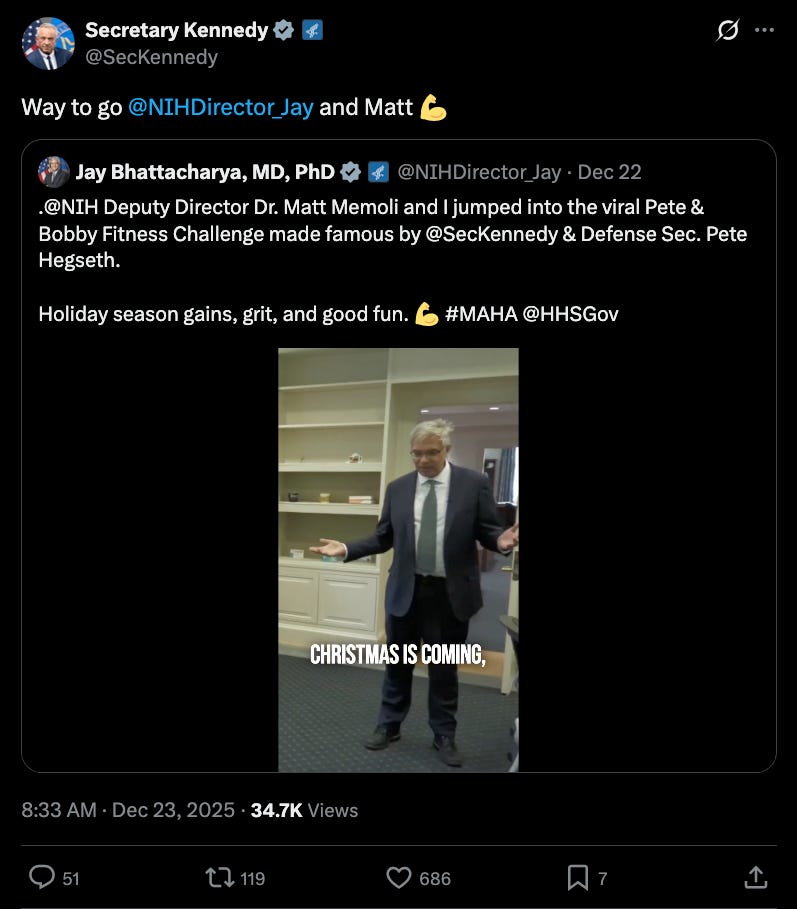
The Department of Health and Human Services (HHS) pushes me dangerously close to a health crisis nearly any time I see any of their social media content. The past few days, I have been on the verge thanks to a video that is quite possibly one of the most fascinatingly and incomprehensibly cringey things I’ve ever seen. HHS Secretary Robert F. Kennedy, Jr. was the latest to deliver the holiday gift everyone has put on their list to their hellsite feeds: a video of National Institutes of Health (NIH) Director Jay Bhattacharya and Principal Deputy Director Matthew Memoli taking the Pete and Bobby Challenge in what appears to be their private gym.
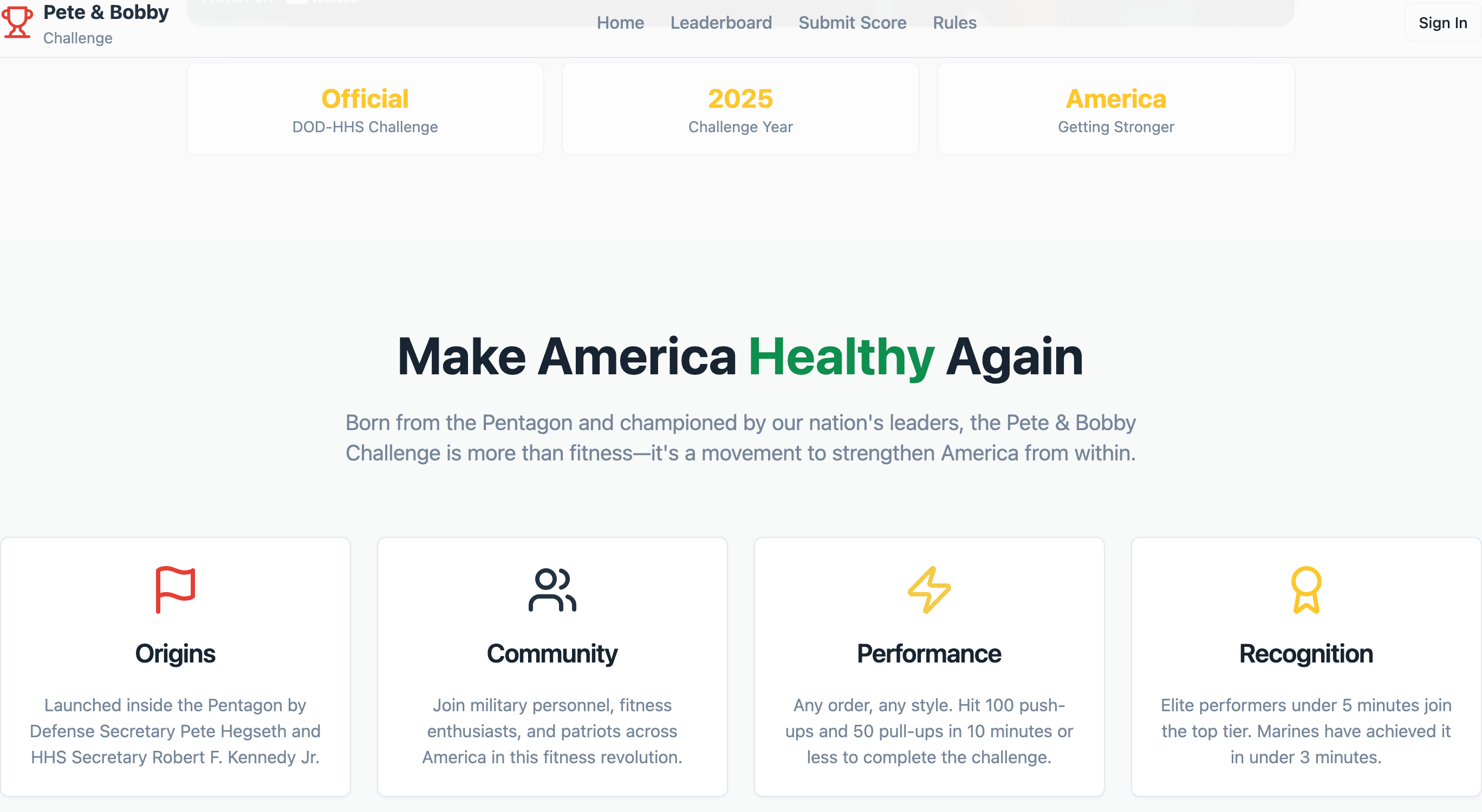
In case you were not aware of the Pete and Bobby Challenge, it is a fitness-promoting collaboration between Kennedy and Secretary of Defense/War Pete Hegseth to do 100 pushups and 50 pull-ups in less than 10 minutes. This is because it was “launched in the Pentagon” as a movement to strengthen America from within by having “military personnel, fitness enthusiasts, and patriots across America” film MAHA-MAGA propaganda videos for free.
Nobody likes making propaganda videos more than “Podcast Jay,” so he enlisted Memoli and filmed this clip showcasing his unique pushup technique, which I can only describe as movement-conserving. Judging by the EXTREME graphics at the beginning and the bitchin’ guitar riffs on that soundtrack, at least one federal employee was unfortunate enough to have been assigned the Herculean task of editing this thing to butch up the top two NIH officials as much as possible. American taxpayers might question whether making a MAHA propaganda video documenting Memoli grunting his way through approximately one-tenth of the pull-ups required for the Pete and Bobby Challenge is an appropriate use of funds, staff, and resources meant for advancing scientific research.
Neither of these prime physical specimens posted their scores like the other recruits to this fitness revolution, so it’s anyone’s guess whether they actually completed the Pete and Bobby Challenge. I analyzed the footage of Memoli lumbering out of his office like Frankenstein’s monster after being summoned to the gym to watch Bhattacharya dance with an elliptical machine, and thus speculate that they were both Gold Standard DNFs. It’s completely on-brand with both their practice of “radical transparency” in data sharing and their opaque leadership style that they didn’t disclose their scores. No need to share information that doesn’t advance MAHA goals, which in this case is convincing viewers that Bhattacharya and Memoli are fun and likable guys despite the fact that they are destroying American science.
Other than being a glimpse into how divorced from reality Bhattacharya is in terms of how his “Christmas is coming, we gotta get in shape!” routine lands with those who aren’t MAHA-pilled, this only thing this video accomplished was wasting government resources and everyone’s precious time and mental coherence. These guys are not funny or quirky or lovable. They are willing functionaries of a regime that has ordered them to destroy the institution they were appointed to lead. Why would anyone want to see their workout routine? Multiple reports indicate that they are widely disliked at NIH. They are venal toadies whose only accomplishments on the job have been destroying entire research programs, ending careers, and firing people for objecting to illegal, politically-driven, and discriminatory grant terminations. There is zero demand for content featuring Memoli and Bhattacharya cracking unfunny jokes in the locker room after accumulating underboob sweat together.
A recent article in The Atlantic suggested that Bhattacharya is regarded as a useless mouthpiece who mindlessly works the right-wing media and podcast circuit parroting MAHA talking points about NIH research. Memoli is a tyrant ruling the NIH with a deep hatred for diversity, equity, inclusion, and vaccine mandates, an unquenchable thirst for grant-cancelling, and a punitive, vengeful iron fist. They reportedly don’t deign to mingle much with the rank-and-file at NIH, which might explain why they had the gym all to themselves.
Bhattacharya and Memoli bonded over their shared loathing for vaccine mandates during the pandemic. Both are particularly pissy about criticism they have received from infectious disease researchers, for their scientific work and for their policy ideas. Both are medical freedom-loving, diversity, equity, and inclusion-hating apparatchiks who complain that being wrong or abusive is tantamount to being censored. Both have collaborated to create a pervasive culture of fear at NIH and among NIH-funded researchers. Both are very special boys whose specialness has been overlooked by the NIH establishment and now, it’s time for payback.
The CDC has been gutted by loss of its leadership, essential staff, and a domestic terror attack and transformed into a MAHA political organization. The FDA is a chaotic whirlwind of ineptitude, conspiracy-addled corruption, and Danish supremacism. However, apart from several large purges earlier in the year, the collapse of NIH has been quieter. Podcast Jay has been busy speaking and collecting awards while on tour at all the prominent conservative and medical freedom political conferences, most recently returning from TPUSA AmericaFest 2025 to mourn Charlie Kirk and champion free speech. This creates an illusion that everything is just business as usual back in Bethesda, while Memoli dismantles our national biomedical research portfolio, one terminated scientist or grant at a time. Memoli’s podcast resume is much shorter than Bhattacharya’s and he is not well-known, so it’s not as obvious that he is the primary effector of the destruction of American biomedical research. Bhattacharya preens for the camera, and Memoli does the dirty work without undue attention.
They are both killing American science. Memoli swings the axe, while Bhattacharya hides the bodies by whining disingenuously about public trust on Steve Bannon’s War Room. They both commit the murder. And they and all their cronies get rewarded for their loyalty to the regime.
If you can’t make it, break it
These two sure have been busy back in Building 1. They’ve been writing about their many successful endeavors, like this gem in The Spectator describing their zeal for slashing grants that are even vaguely related to diversity, equity, or inclusion. Bhattacharya goes so far as to complain that orthodox DEI-ist hardliners were “creating a hostile work environment” by criticizing would-be fascist bigots for freely sharing their views at Stanford in 2020. Woke academia was up to its usual free-thinking intellectual dissident-silencing, and for the gazillionth time subjected Bhattacharya’s ideas about public health and pandemic management to criticism. This complaint about silencing would ring truer if not for the dozens of appearances he made on Fox News, BBC, NewsMax, and OANN during the first year of the pandemic.
In reality, free speech hero Bhattacharya was enforcing a list of banned words based on Presidential Executive Orders against diversity, equity, and inclusion and “gender ideology extremism.” They bemoan “activist courts” that are interrupting their gleeful firing and grant termination spree, but fail to note that the most blistering decision against the terminations came from a judge appointed to the federal bench by woke icon Ronald Reagan. Memoli was so deeply aggrieved by oppressive diversity, equity, and inclusion initiatives that he terminated grants even after being ordered not to by a federal judge.
Bhattacharya and Memoli have further manufactured pretext for additional grant terminations by writing another piece in a libertarian think tank’s blog about pandemic preparedness, and how we shouldn’t do it anymore because virology and vaccine research starts pandemics. Jeremy Faust, MD and I reviewed the piece line by line and every sentence in the entire essay is factually incorrect and grossly dishonest.
It is also extremely hypocritical. Memoli is an influenza virologist whose entire research program falls into the pandemic preparedness category: he studies pathogenesis and immunity, develops and tests vaccines and therapeutics, and investigates virus evolution in the context of emerging antiviral resistance or immune evasive mutations. Memoli was nonetheless happy to co-author an essay claiming that molecular virology and so-called “dangerous gain of function” (DGOF) research must end (unless he’s doing it), pursuant to Trump’s Executive Order on Improving the Safety and Security of Biological Research. A primary MAHA directive is attacking infectious disease and vaccine research at any cost. For Bhattacharya and Memoli, it’s also an opportunity to settle outstanding scores.
This past week has been a doozy. Bhattacharya has been criticized for moving too slowly to end animal research, earning him a letter from some Congresspeople demanding that he get a move on and defund the National Primate Research Centers. On top of that and the critical piece in The Atlantic, a (generous, in my opinion) profile in Science portrayed him as caught at the center of a complex web of competing priorities and demands, with a mixed outlook for his future. No amount of sympathetic quotes from supportive senior colleagues could disguise that Laptop Lysenko’s track record as NIH Director demonstrates that he is an unprincipled loyalist, a lab leak conspiracy theorist, a hapless lackey, an ineffective backchannel political operative, and a fully on-message pseudoscientific MAHA propagandist who is still butthurt about people criticizing his mass infection proposal in 2020. He has accomplished very little besides producing episodes of Director’s Desk.
Memoli is portrayed as the “bad cop” of the “Jay and Matt” dyad, whose management style is described as rule by fiat. His oppressive rule has fostered paranoid workplace misery among NIH employees, in part due to his practice of firing or demoting officials who objected to his cutting grants based on Kennedy and Office of Management and Budget (OMB) Director and Destroyer of Agencies Russell Vought’s ideological priorities.
To distract from all these negative reviews, Bhattacharya and Memoli did what they do best: force people out of the agency and replace them with loyalists, terminate virology grants, and then blame it all on DGOF. According to Jon Cohen at Science, the latest head to roll belongs to National Institute of Allergy and Infectious Diseases (NIAID) Division of Microbiology and Infectious Disease (DMID) Director John Beigel. DMID is the part of NIAID that funds most non-HIV virology research. Beigel was reportedly blamed for not DGOF-flagging a grant that studied seasonal flu virus evolution relative to the host’s immune system. He resigned rather than accept a demotion.
This study did involve work that could create immune evasive or antiviral resistant mutants, which falls under definition c of section 8 in the Executive Order on Improving the Safety and Security of Biological Research. However, it fails to meet the Executive Order’s standard for causing “serious societal consequences.” These viruses are garden-variety seasonal flu that circulated broadly in the recent past, meaning there are high levels of population immunity in the present. They are very unlikely to spread in the population or cause severe disease. The biocontainment level used for these viruses is appropriate. These studies are not “dangerous,” they do not threaten serious consequences for society or health, and they do not carry any risk at all of causing a pandemic. However, health economist Bhattacharya assessed this differently, drawing on his zero expertise in virology research.
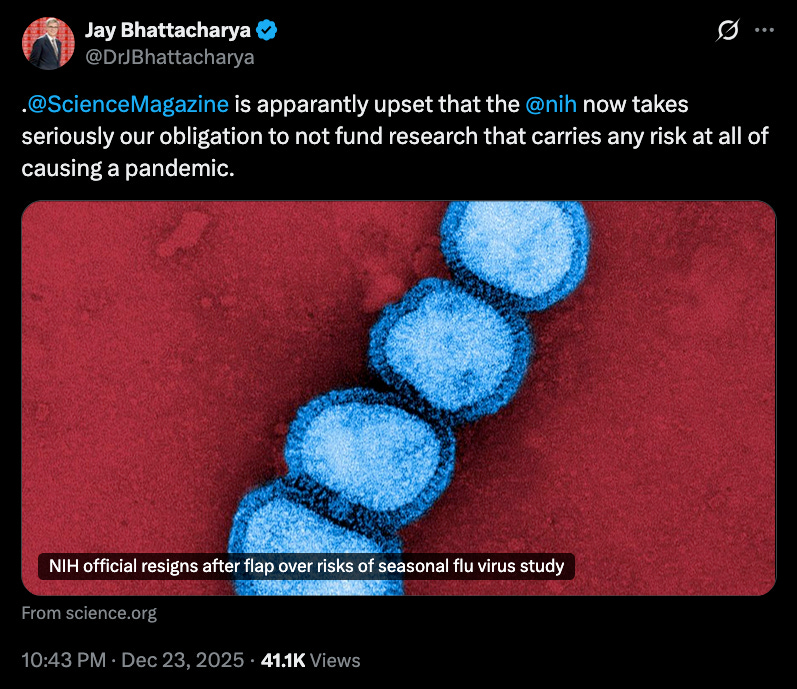
The reality that Bhattacharya elides in his standard protests—which, like this, often take a petulant, offended, self-pitying tone—is that the terminated research is not only not dangerous, it has obvious scientific value. The grant focused on studying how seasonal flu viruses, which kill thousands of people each year and can be prevented or ameliorated with vaccination, evolve in response to immune pressure. Understanding how flu viruses evolve allows us to make better vaccines and use antiviral drugs more effectively. This research is extremely relevant to public health. It only qualifies as DGOF if assessed by completely dishonest standards such as Bhattacharya’s that deprioritize expertise in favor of political expediency.
Speaking of, Bhattacharya is at the Icarus meme stage of coping with criticism about this issue. I suppose this is a weak threat to virologists everywhere: if you do high quality research with a timely, direct impact on public health that happens to be funded by NIAID, you may find yourself flying too close to the sun.
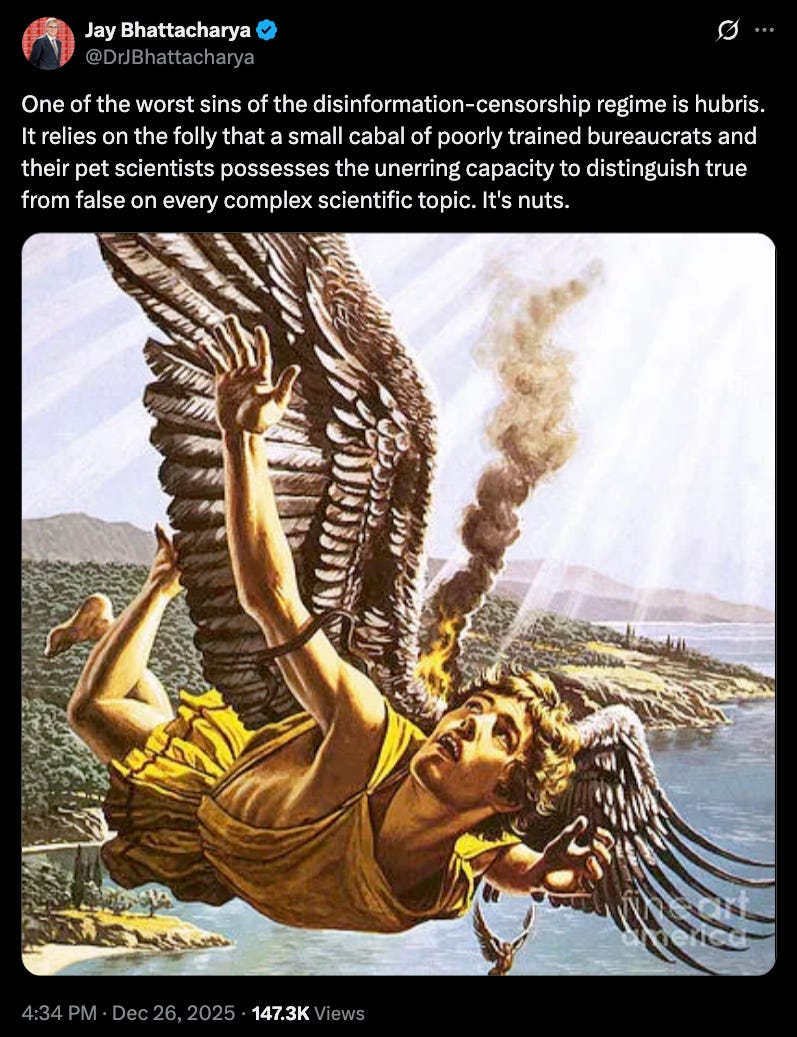
Research that was awarded based on scientific merit and directly addresses urgent health questions—such as how seasonal flu can evade immune responses—is not “hubris.” Grants are not awarded by “a small cabal of poorly trained bureaucrats” to their “pet scientists.” Prior to the MAHA regime, NIH grants were dissected in peer review and then funded based on the quality and impact of the work proposed. To get an NIH grant, you have to be doing work that entire rooms full of experts must agree is worthy of doing. However, I suppose now that expertise is being replaced by ideology, evidence-based review is about to be replaced by political purity. Hubris has certainly become an institutional value at the new NIH since Bhattacharya took the helm.
Other institute directors are also being systematically removed. The long-time, highly respected director of the NIAID Division of AIDS, Carl Dieffenbach, was removed from his position in November. Yesterday, National Institute of Neurological Disorders and Stroke (NINDS) Director Walter Koroshetz was fired after a decade on the job. Beigel is being replaced by David Spiro, a vocal Trump supporter who donated to his presidential campaign. Although Spiro is a career NIH employee who previously worked at DMID, his appointment may be driven more by his political beliefs than his scientific or administrative skill. NIH employees do not sound optimistic about this staffing trend, as one said that “things are about to take another sharp turn for the worse.” Judging by the example set by the current NIH leadership, it certainly seems so.
Your favorite virologist’s least-favorite virologist
As a virologist, I know a lot of other virologists, including ones specializing in influenza and including ones who work at or with NIH’s intramural program. I have yet to hear from a single one of my colleagues that Memoli was making significant intellectual contributions to the influenza field. Memoli ran a lab at the NIH Clinical Center, so a lot of his own work was looking at patients or participants in various trials. His main achievement was developing a human challenge model of seasonal influenza that can be used to test different drugs and vaccines.
Human challenge studies are exactly what they sound like: deliberate infection of human volunteers so you can study how a virus causes disease or how well a vaccine protects against it. Memoli’s model was established using recently circulating seasonal flu isolates (H1N1 and H3N2 subtypes). He has used it to test monoclonal antibodies and vaccines. I think he plans to use it to test his latest vaccine.
Memoli is collaborating with Acting NIAID Director Jeffery Taubenberger to develop a “next-generation, universal” flu vaccine they have deemed “Generation Gold Standard:” a quadrivalent (meaning made with 4 different viruses) whole-virus inactivated vaccine. To make this vaccine, you grow up the four different viruses, inactivate the viruses with a chemical called beta-propiolactone (BPL), and you’ve got a vaccine. It is century-old vaccine technology that is still used today. It works for flu. But the question isn’t whether it will work at all, it is whether it will work against everything. Will this work as a universal vaccine?
Universal flu vaccines are a long-time focus of NIAID’s research portfolio. The idea behind a universal flu vaccine is that you could get one flu shot that would protect against all flu. The flu shot would not need to be updated annually to match circulating strains, because the universal flu shot protects against them all. Any virus, any subtype, any clade, any genotype.
Generation Gold Standard attempts to achieve universal coverage by making recombinant reassortant vaccine viruses that include some avian subtypes (H5, H7, N8, N9) that don’t circulate in people. In the sole paper describing preclinical evaluation studies in mice and ferrets, Park and colleagues show that it is protective against heterosubtypic challenge in mice and ferrets. That means infecting animals with a different HxNx subtype than one they were immunized with (the vaccine contains H1, H3, H5, and H7 and N1, N3, N8, and N9).

This vaccine protected mice against a lethal challenge with two heterosubtypic viruses that were selected based on their enhanced ability to kill mice (yes, that’s DGOF). They had similar findings using H2N7 and H3N2 viruses in the ferret model. A universal vaccine must protect across subtypes, and it appears that Generation Gold Standard does.
However, it does not completely protect against lethal H5N8 infection in mice. It also does not protect against weight loss (an indicator of morbidity) for most of the challenge viruses, regardless of whether immunization was intranasal or intramuscular. That suggests that this vaccine protects against lethal disease for the viruses tested, but not against disease altogether. This is consistent with the data on whole virus inactivated vaccines for influenza that has accumulated since they were developed in the 1940s. It also calls into question this vaccine’s utility as a universal vaccine.
Kennedy and Bhattacharya also claimed that whole virus vaccines elicit broader immune responses than other platforms. This is only partly true. Current flu vaccines are usually split virion inactivated vaccines (the virus particles are broken open) or recombinant subunit vaccines (HA protein made in insect cells). Inactivated vaccines will have more viral antigens available than the subunit vaccines (which are only one protein), since there are other viral proteins beside HA and NA inside the virion. Split virion formulations can result in some of these proteins being modified or degraded, so whole virus formulations do offer the broadest selection of antigens for the immune system to target. They are second only to live-attenuated vaccines in terms of their ability to induce immune responses to many different viral antigens.
However, the claims of broad immunity are based only on some antibody data and flow cytometry data to phenotype different T cells and natural killer cells. They did not look at antigen-specific responses, antibody neutralization, or cytokine production. There is no data demonstrating that this vaccine provides broad enough immunity that it would provide protection against any flu virus that might cross your path. Given that this vaccine does not protect mice from morbidity and it reduces but does not eliminate lung pathology in ferrets, Generation Gold Standard’s immune breadth will likely not have a significant impact on its effectiveness. Whole virus vaccines are also thought to be more reactogenic (cause more side effects), which is one reason why they aren’t used as much anymore for flu.
There is no reason to think Generation Gold Standard is any different from any other whole virus inactivated quadrivalent flu vaccine, because it isn’t. It is literally a flu vaccine made with the same technology as other flu vaccines have been for decades. Those don’t provide universal protection even within subtypes. Including a few avian subtypes and calling it universal based on a few animal studies with heterosubtypic viruses is premature. I don’t think it’s going to work as a universal vaccine.
Dangerous Gain of Funding
Now, I already have a big problem with what Memoli and Bhattacharya have done to science in general and especially to virology, because Memoli is a virologist himself. He knows why virologists do different kinds of studies. He knows how virologists mitigate risks for working with dangerous viruses because he does it routinely in his own research. Memoli knows that the work described as DGOF is not dangerous.
But as seems to be the Gold Standard for NIH leadership practices, Memoli appears to be applying standards to others that he doesn’t apply to himself. He awarded himself and Taubenberger half a billion dollars to develop Generation Gold Standard, diverting funds from a COVID-19 vaccine development initiative. Let me repeat: Memoli, with Bhattacharya’s blessing but without any apparent scientific merit review, gave himself $500 million dollars to develop an old-timey, unlikely-to-work vaccine that has been tested exclusively using viruses that are the products of DGOF.
A few months back, Bhattacharya hosted Taubenberger on Director’s Desk to discuss how exciting and cool virology research is when it’s not DGOF or virus hunting. Taubenberger thinks that DGOF can be useful and justifiable sometimes (Bhattacharya sort of agrees), but should only be done in government labs. It is convenient that he works in a government lab, since he’s met and exceeded the Gold Standard for DGOF since 2005, when he reconstructed 1918. Since then, nearly every paper he’s published contains experiments that would qualify as DGOF, including actual gain-of-function research with highly pathogenic avian influenza and 1918. Good thing he and Memoli have $500 million to apply his Gold Standard DGOF expertise to Generation Gold Standard!
Gold Standard Silencing
Which brings me back to the seasonal flu grant that was cancelled. This grant was awarded to Christopher Brooke at the University of Illinois, who has done outstanding work demonstrating the impact of the host on virus evolution. His lab studies how host immune responses influence virus evolution, and the impact that has on both the virus and the host. It also does not constitute DGOF, as it uses low pathogenicity seasonal flu viruses that do not pose a pandemic risk, even when they are vaccine-evasive or antiviral-resistant. No serious societal consequences will ensue.
One example is this recent study published in Virus Evolution, where Brooke’s lab showed that the evolution of HA antibody escape mutants was dependent on the activity of NA on the virus. HA and NA are the two proteins on the surface of influenza virions (virus particles) and they are also the two primary antigenic targets for vaccines. HA binds the receptor, sialic acid, to allow the virus to enter the cell. NA is an enzyme that cleaves sialic acid, which allows the virus to leave the cell. Thus, HA and NA levels must be balanced: too much NA and it will cleave all the sialic acid, preventing HA from binding its receptor and entering the cell; not enough NA and newly made virions won’t be released from the host cell to go forth and infect another. This balance can be tipped one way or another by many different selection pressures: mutations in HA and NA that impact how HA binds sialic acid or NA cleaves it can have a compounding effect or cancel the effect of the other (epistasis), antibodies that bind or neutralize HA or NA can have different effects on their receptor binding (HA) and receptor cleaving (NA) function, and there is tremendous diversity in terms of both influenza viruses and host immune responses. All of these variables drive flu evolution, which in turn impacts immunity and vaccine effectiveness. Brooke’s lab has contributed significantly to our understanding of the evolutionary drivers and constraints that influence flu evolution, immunity to HA and NA, and vaccines.
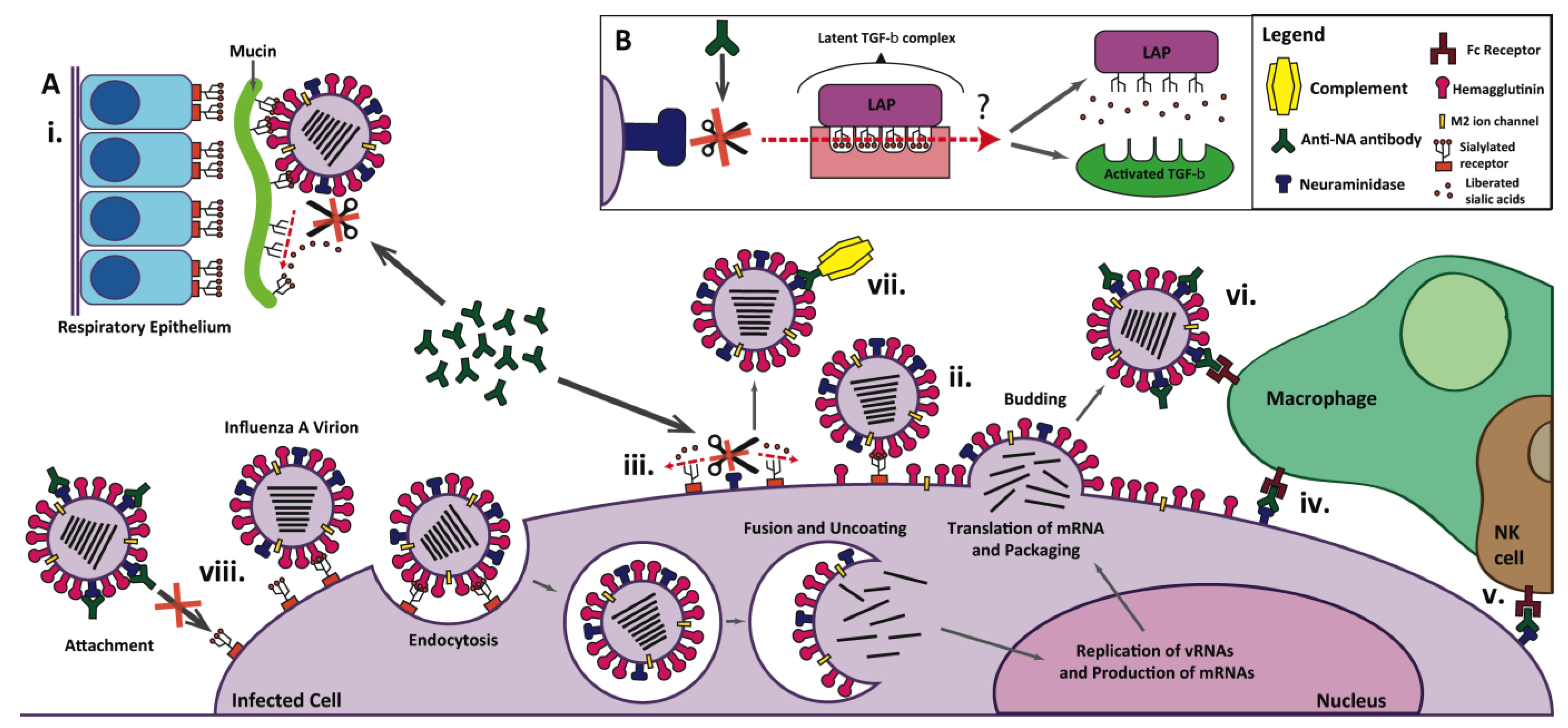
NA does a whole bunch of things during influenza virus infection. It enables virions to escape mucus traps, it releases newly assembled progeny virions from the host that they’ve budded from, and it can interact directly with the host to activate or suppress different responses to infection. Because NA cleaves the virus receptor that HA binds, its activity has a direct impact on antibodies to HA, since neutralizing antibodies often bind that part of HA. Different NA genes have different levels of activity, and NA activity is itself impacted by antibodies against NA. Also, the frontline class of antivirals used to treat flu are NA inhibitors, so their use can influence NA activity and exert selection pressure on HA as well. This is very complex in the context of the real world, in which different people are infected with different viruses that have different levels of NA activity many times in their lives and mount different immune responses to them, but it’s important to understand how existing immunity drives the emergence of new variants to ensure that vaccines are as protective as possible.
One real-world implication of this study is that a truly universal flu vaccine would need to account for complex variables, like NA activity driving HA evolution, and how they might select for vaccine-evasive viruses. If viruses emerge that can evade protection induced by a universal flu vaccine, that flu vaccine is no longer universal. This is bad news for Generation Gold Standard, since its quadrivalent approach limits protection to only 4 HA (H1, H3, H5, and H7) and NA (N1, N3, N8, and N9) subtypes. There is already considerable variation within subtypes, so this vaccine is unlikely to be completely protective against the subtypes it does include, much less completely different ones. The increased breadth of immunity produced by whole-virus vaccines is not impactful enough to provide protection against all influenza viruses, which we know from using these vaccines for 80 years. Other antigens in influenza are influenced by immune selection pressure and can evade or manipulate host responses in different ways that also likely drive virus evolution (Brooke’s lab does great work on this too). Not only is Generation Gold Standard unlikely to work as a universal vaccine due to the narrow breadth of influenza antigenic diversity that it covers, but may even select for vaccine-evasive strains and then goodbye, universal vaccine.
Since DGOF is proclaimed and enforced selectively, I wondered why this grant in particular caught Memoli and Bhattacharya’s merciless gaze. This is not the only research that NIAID funds on seasonal flu, and other labs use similar experimental approaches and address related research hypotheses. Why was this grant singled out?
Perhaps it reminded Memoli too much of his own work! Memoli also studies the impact of HA and NA immunity on virus evolution. He has identified immune escape, multiple antiviral resistance, and virulence mutants and done experimental evolution studies in which he selected them in cell culture and in his own human challenge model. Yes, that’s right: Memoli has created and also intentionally infected human volunteers with these supposedly dangerous and potentially pandemic-causing viruses. He then used these humans to select for seasonal flu viruses that evade host immune responses, including to therapeutic antibodies and vaccines. Being Principal Deputy Director of NIH can certainly give you new, tyrannical means of getting a competitive advantage, since you can tank their grants for allegedly doing DGOF that you do yourself (on humans!!!).
I did a little thought experiment about what would happen if the grant’s approach to studying the impact of immune pressures on flu evolution to better predict vaccine evasion were applied to Generation Gold Standard. I suspect it would likely show, as data from inactivated flu vaccines has shown for the last 80 years, that it is not effective against all flu viruses across all subtypes. Inactivated flu vaccines are terrific and they save lives, but they are limited in their effectiveness. I predict that Memoli’s own inevitable human challenge study with his validated seasonal viruses will show that, as well—provided he shares the data transparently (I predict that he won’t!). And Generation Gold Standard immunity will drive the evolution of seasonal viruses that it is not very effective against.
I think that Generation Gold Standard will select for vaccine-evasive viruses, since both NA activity and HA immune pressure vary a lot depending on the seasonal viruses that are circulating. Memoli has published papers about this. If sera (antibodies) from people vaccinated with Generation Gold Standard were tested against a panel of seasonal viruses, I suspect there would be relatively low neutralizing titers (concentration of antibodies that inactivate the virus) for many of them. If you continuously grew seasonal viruses in these sera, you would see HA neutralization escape variants begin to emerge. Now imagine that selective environment in the blood of every person who received that vaccine. There are a lot of flu viruses circulating and I imagine that immune evasive viruses would emerge fairly quickly, just like they normally do with inactivated vaccines.
I’m willing to bet that there’s also a relationship with HA escape with NA activity. That could be exacerbated for H3N2 viruses since Generation Gold Standard does not immunize against N2, which could down-modulate NA activity. I think the type of research in the cancelled grant would likely show that Generation Gold Standard does not work as a universal vaccine or offer anything outside the scope of existing inactivated vaccines. If Generation Gold Standard selects vaccine-evasive viruses, it proves without a doubt that it does not provide “universal” protection. It completely negates its value as a universal vaccine.
Memoli has 500 million reasons to fear credible experts who could objectively assess Generation Gold Standard data to determine whether or not it works. Declaring research that might expose Generation Gold Standard’s shortcomings to be DGOF and terminating grant funding is one way to get ahead of experts who could potentially raise inconvenient scientific issues about the official MAHA vaccine platform. It not only removes a potential obstacle to achieving their ideological objectives, it puts the entire virology community on notice that anyone could be DGOFed and defunded for the crime of doing beneficial, rigorous research that threatens administration goals.
Bhattacharya and Memoli are using DGOF as a weapon to eliminate opposition, suppress science, avenge themselves on the virologists they think wronged them, and enrich themselves. The corruption is appalling. The unrepentant hypocrisy makes it somehow even worse to bear.
The Matt and Jay Challenge
This all brings me to the end of this very long saga, which began with me innocently watching Matt and Jay’s workout video and reflecting on how much I disliked it. I could not shake the juxtaposition of these two literal bad actors grinning and filming slop content for the NIH website with the many reports of their destructive ineptitude, dishonesty, ruthlessness, mismanagement, and ideological servility.
I was supported by NIH funding for most of my career. Without NIH funding, I could not have become a virologist, which is a profession that I deeply love and that gives me the opportunity to make a positive impact on the world by contributing to research that improves our health. I continue to be inspired by my colleagues who have used NIH funding to advance our understanding of viruses: how they infect their hosts, how they replicate, how they spread, how they cause disease, and how we can counter them. NIH has done incredible things for me personally as a scientist and for my field, but it has done incredible things for all Americans too. Virtually every new drug, treatment, or vaccine was funded by NIH at some point in its discovery or development. NIH has provided extraordinary returns on taxpayer investment.
Which is why I do not understand how Bhattacharya and Memoli can live with their actions, given they both know the value of NIH research, to them as individuals and to society. As a health economist, Bhattacharya can quantify the benefits of NIH research, as well as the consequences from shutting it down. As a virologist, Memoli knows exactly what risks different viruses and different experiments present and how to mitigate them, because the benefits of virology research are extraordinary. Both have chosen to abandon expertise, including their own.
In the future, “when this is over”, the worst and most damning feature of Bhattacharya and Memoli’s leadership will be their shamelessness. They do not even pretend that NIH prioritizes science anymore—their aims are not scientific or directed toward the public good, but political. That’s why their primary achievements at NIH so far involve defunding research programs, forcing career employees out, shutting down entire programs through selective policy changes and enforcement, whining about silencing and trust, prolific lying, and a shit-ton of loathsome podcast appearances.
After spending this much time reflecting on the “Matt and Jay” hegemony, I was in a dark mood. I decided to do something constructive to make myself feel better, or at least like I was occupying the moral high ground: I went through all of Memoli’s papers to assess how much of his own work would meet the same criteria for DGOF that he and Bhattacharya are increasingly targeting for termination. It turns out that Memoli is such a productive DGOF researcher that I created a rating scale to qualitatively assess how hypocritical each paper was on a scale of obvious to infuriating (see Appendix, below).
I went down such a rabbit hole reading Memoli’s papers (and have been unfortunately subjected to Bhattacharya’s views for the past five years) that I started thinking of it as the Matt and Jay Challenge: find all the receipts that demonstrate their rank hypocrisy. All the evidence of them saying one thing and then doing the exact opposite. Every example of them accusing an ideological opponent of doing something they themselves have done. I continue to find more. If anyone wants to take the Matt and Jay Challenge with me, I’ll let you know when I think I’ve collected them all.
People need to be aware that what is happening at NIH will mean the end of scientific research in America. Like most of the federal government, NIH is being transformed into a political organization that serves the regime rather than one that serves the American people. It is being corroded by Bhattacharya and Memoli’s corruption and mandate to destroy and rebuild NIH as a political organization. This will have a profoundly negative impact on our health, on the economy, and on our democracy.
I refuse to believe that Americans will allow the two corrupt, clownish numpties who made the most awkward, unengaging, and unpleasant to watch Pete and Bobby Challenge video of all time to annihilate what is truly a great American success. The NIH has made America wealthy. NIH funding has made the entire world more secure and resilient to serious health and security threats. NIH research has saved millions of lives. Bhattacharya and Memoli have collaborated with the Trump regime to ravage NIH’s capacity to conduct innovative research. They are taking American biomedical science apart and enriching themselves in the process. Both need to be accountable for the damage they have done. They are working against the interests of the American people. Both need to be permanently removed from NIH and from government service altogether.
Appendix
I looked up some papers authored by Memoli describing work that may violate the Executive Order on Improving the Safety and Security of Biological Research. Inclusion on this list is based solely on whether the papers describe work that would violate the Executive Order as it is being interpreted now, to the best of my understanding. Inclusion is not a statement on the quality of the research or the actual risk that the work presents.
I’d also like to add that I do not think any of this work is dangerous, despite my opinion that it technically meets definitions of DGOF in the Executive Order, because the risks were properly mitigated. This work was done with institutional oversight—by NIH itself and theUS government—and carried out in appropriate biocontainment by experienced flu researchers. In addition, this research is scientifically valuable and highly relevant to pandemic preparedness and public health. Taubenberger’s work in particular has contributed immensely to our understanding of influenza viruses and flu pathogenesis. This has advanced antiviral drugs and vaccines in the pipeline and hastened our progression towards a universal vaccine. Memoli has contributed in his own right, as well as in collaboration with Taubenberger. Each study has different risks and different approaches to mitigation (which in my opinion were adequate and rigorous), but all of them were beneficial.
(a) enhancing the harmful consequences of the agent or toxin
Park et al. An inactivated multivalent influenza A virus vaccine is broadly protective in mice and ferrets. Science Translational Medicine, 2024.
DGOF: Uses recombinant reassortant avian viruses selected for increased pathogenicity to evaluate the Generation Gold Standard vaccine
Hypocrisy Level: Infuriating. In their City Journal blog, Memoli and Bhattacharya defined DGOF as research aiming to “evaluate the risk of each pathogen infecting humans by testing its ability to penetrate human cells—and sometimes even genetically modifying it to make this more likely.” They acknowledge that molecular virology “may sound crazy to the uninitiated, but it’s a critical step in the playbook. The idea is to estimate the likelihood that the infectious pathogen will mutate in a way that could conceivably threaten humans.” Sounds like terrible DGOF…except it also sounds a lot like the work described in this paper that Memoli co-authored! The viruses used in this study were engineered to be representative of unknown future viruses that could conceivably threaten humans and they were selected based on being more pathogenic. These viruses don’t just “penetrate” the cells of a mammalian host, they replicate to higher titers and kill mice. We don’t know what they would do in humans, but they certainly have the potential to be pathogenic. To write an entire essay stating that this type of research causes pandemics and has no scientific value is disgraceful, considering he has awarded himself $500 million on data generated through this type of research.
(b) disrupting beneficial immunological response or the effectiveness of an immunization against the agent or toxin
Gao et al. Antigenic Drift of the Influenza A(H1N1)pdm09 Virus Neuraminidase Results in Reduced Effectiveness of A/California/7/2009 (H1N1pdm09)-Specific Antibodies. mBio, 2019.
DGOF: Uses a recombinant reassortant H6N1 virus engineered to be resistant to anti-H1 HA antibodies.
Hypocrisy Level: Glaring. Memoli co-authored a paper that was studying virus evolution by making novel influenza viruses capable of escaping immunity. The stated reason that NIH gave for canceling Chris Brooke’s grant was that it “could create influenza viruses capable of escaping immunity or resisting effective influenza drugs.” Bhattacharya tweeted that the grant needed to be cancelled because “any risk at all” of starting a pandemic was too high. Yet Memoli did a study that intentionally created an influenza virus capable of escaping immunity in the human population.
(c) conferring to the agent or toxin resistance to clinically or agriculturally useful prophylactic or therapeutic interventions against that agent or toxin or facilitating their ability to evade detection methodologies
Park et al. Pre-existing immunity to influenza virus hemagglutinin stalk might drive selection for antibody-escape mutant viruses in a human challenge model. Nature Medicine, 2021.
DGOF: Selection for anti-H1 HA antibody-resistant mutants in human volunteers
Hypocrisy Level: Glaring. For a guy who is so concerned about selecting antibody-evasive seasonal flu viruses in the pursuit of studying immune pressures on seasonal flu evolution, Memoli sure does it a lot himself! In this study he and his co-authors used experimentally-infected human volunteers to select immune-evasive H1N1 mutants. They also deliberately inserted the resistant mutant into the 2009 backbone and not only showed that it could evade therapeutic monoclonal antibodies, but they used those antibodies to select for antibody-resistant mutants. It is clearly DGOF by the criteria that has been applied to others. This seems like a pattern: do Memoli and Bhattacharya only care about DGOF when other people are doing it, especially if it competes with or threatens Memoli’s work?
(d) increasing the stability, transmissibility, or the ability to disseminate the agent or toxin
Jagger et al. The PB2-E627K Mutation Attenuates Viruses Containing the 2009 H1N1 Influenza Pandemic Polymerase. mBio, 2010.
Park et al. An inactivated multivalent influenza A virus vaccine is broadly protective in mice and ferrets. Science Translational Medicine, 2024.
DGOF: Inserting mutations that are known to increase fitness in mammalian hosts
Hypocrisy Level: Infuriating. Both of these studies describe instances in which Memoli authored papers where they inserted mutations known to increase fitness (ability of the virus to replicate) in mammalian hosts. Increased fitness means increased replication, which often means increased shedding and increased transmissibility and dissemination. In both studies, they insert these into a variety of avian and reassortant viruses with the intent of increasing fitness. This is like premeditated GOF.
(e) altering the host range or tropism of the agent or toxin
Jagger et al. The PB2-E627K Mutation Attenuates Viruses Containing the 2009 H1N1 Influenza Pandemic Polymerase. mBio, 2010.
Park et al. An inactivated multivalent influenza A virus vaccine is broadly protective in mice and ferrets. Science Translational Medicine, 2024.
DGOF: Inserting mutations that are known to alter host range and tropism.
Hypocrisy Level: Infuriating. Both of these studies also describe examples of Memoli inserting mutations known to alter host range and tissue tropism. Increased host range means that the virus adapts to infect another species. Virologists do this in the lab so that we can safely study virus disease in different model systems. Experiments using those models have shown that expanded tropism (which cells the virus infects) often can mean more widespread or severe disease. In both studies, they insert these mutations to test the hypothesis that they will increase virulence. GOF in the first degree.
(f) enhancing the susceptibility of a human host population to the agent or toxin
Memoli et al. Validation of the wild-type influenza A human challenge model H1N1pdMIST: an A(H1N1)pdm09 dose-finding investigational new drug study. Clinical Infectious Diseases, 2015.
Memoli et al. Evaluation of Antihemagglutinin and Antineuraminidase Antibodies as Correlates of Protection in an Influenza A/H1N1 Virus Healthy Human Challenge Model. mBio, 2016.
Han et al. A Dose-finding Study of a Wild-type Influenza A(H3N2) Virus in a Healthy Volunteer Human Challenge Model. Clinical Infectious Diseases, 2019.
Xiao et al. Deep sequencing of 2009 influenza A/H1N1 virus isolated from volunteer human challenge study participants and natural infections. Virology, 2020.
Han et al. Safety and Efficacy of CR6261 in an Influenza A H1N1 Healthy Human Challenge Model. Clinical Infectious Diseases, 2020.
Pleguezuelos et al. Efficacy of FLU-v, a broad-spectrum influenza vaccine, in a randomized phase IIb human influenza challenge study. npj Vaccines, 2020.
Park et al. Pre-existing immunity to influenza virus hemagglutinin stalk might drive selection for antibody-escape mutant viruses in a human challenge model. Nature Medicine, 2021.
DGOF: Human challenge studies in which volunteers are deliberately infected, including with an antibody-evasive mutant.
Hypocrisy Level: Infuriating. I find it interesting that, in my own observation, a lot of people who are very concerned about DGOF and lab leaks seem to support human challenge studies, in which volunteers are deliberately infected with a virus, or strategies that focus on “natural” (infection-acquired) immunity. I have never understood how Bhattacharya reconciled his seemingly contradictory beliefs that the pandemic virus was created by deadly DGOF using NIH money, but also everyone should go out and get infected with it right away because “natural herd immunity” is so great. I don’t understand how a virologist can seriously assert that using some methods, like reverse genetics, to study different viral mutations is reckless and dangerous if you do it in a lab, but using the same method to generate a virus that you use to infect a human volunteer is somehow much safer. That would be a much more persuasive argument if Memoli himself wasn’t using molecular virology techniques to make new viruses in the lab and then infecting people with them. Granted, infecting low-risk human volunteers with seasonal flu mutants is not particularly dangerous. But if he’s going to be cancelling grants for simply studying how seasonal flu viruses evolve because he thinks studying seasonal flu mutants is dangerous, maybe he should think about the risk his own seasonal flu mutants present to the humans he is deliberately infecting with them!
(g) generating or reconstituting an eradicated or extinct agent or toxin
Memoli et al. An early 'classical' swine H1N1 influenza virus shows similar pathogenicity to the 1918 pandemic virus in ferrets and mice. Virology, 2009.
Park et al. An inactivated multivalent influenza A virus vaccine is broadly protective in mice and ferrets. Science Translational Medicine, 2024.
DGOF: Uses reconstituted 1918
Hypocrisy Level: Obvious. 1918 was reconstituted twenty years ago, so it stopped being extinct in 2005. These studies are not themselves DGOF, although it’s debatable whether using 1918 at all would qualify, since it was resurrected from sequences using reverse genetics. Bringing back 1918 now, however, would be absolutely forbidden by the Executive Order. What about using 1918 now since it has already been brought back? Grants including 1918 work are likely being evaluated for DGOF compliance on a case by case basis since 1918 is also a Select Agent, but I would be very surprised if many researchers are submitting grants proposing any type of 1918 work. The only researcher in the country whose 1918 research is unaffected may be Taubenberger.
Dr. Rasmussen
Thank you for another informative & yes entertaining read. From my vantage point, albeit others may read your post as sarcastic, true however it underscores the 'dark satire' being imposed upon the American citizenry.
'Trumpism' has as its raison d'être, vilify those who disagree & exact revenge upon those who challenge or simply question their policies or actions.
Their quintessential bully & ringleader is motivated by his vanity and a host of insecurities which he manifests with gleeful vengeance, e.g. mocking the deaths of purported criminals/terrorists with his use Merry Christmas 😥
My digression is the reasonable assumption being, any NIH grants you held have been cancelled & zero likelihood of receiving any over the next 3 yr's.
I hope that NRC (Canada) would wisely support any missing funds.
Aside from my rant, thank you also for contributing to my vocabulary if not my lexicon 😊
OMG please LOL...checking definitions for your well chosen prose, my Android Gemini (close as I get to using AI) create the following:
"The hegemon maintained control not through popular support, but through a network of apparatchiks and venal toadies. These bureaucrats saw the regime's survival as their sole raison d'être, and they were more than willing to exact revenge on any scientist who questioned the safety of their gain-of-function research."
Warm regards from snowy NL (not as cold as SK, which my son the 'Mountie' comments on the numerous layers of clothing) that delayed our return to Ontario.
I hope you & your family continue to recover from the "flu".
JJF Phm 🇨🇦
One request: would you please consider writing a short summary of the points at the top of long posts like this?